A young journalist shares the production story behind NASA’s historic Artemis II live stream.
“Who will be our talent? How will we get the right feeds with images from the launch pad?”
By Pedro Cota
Like so many who didn’t get to see live images from the moon of Neil Armstrong taking a giant leap for mankind, I grew up listening to my parents’ stories of what it was like to witness this historic event. In their case, from Mexico. My mom huddled around a black and white television with her brothers and sisters. I never thought I would be involved in broadcasting images of the next lunar program, Artemis, to the world on NASA’s streaming channels and social media accounts. Much less in Spanish.
As NASA contractors, my team and I were tasked with producing the agency’s coverage of the Artemis II launch in Spanish. This was my first time directing an Artemis launch broadcast in person, though I’ve directed Spanish broadcasts for NASA including Artemis I.
I started working as a NASA contractor in 2020 just after earning my master’s in journalism. There was a post on an alumni group indicating the agency was looking for a bilingual multimedia specialist. I got the job and worked with NASA’s communications team creating video content in Spanish. Three years later, I switched to another contractor role as a senior media specialist where I continue to produce multimedia content in both English and Spanish.
My current group, Space 360, is a small team of media specialists who worked with our NASA communications colleagues, Kennedy Space Center (KSC) producers and TV engineers, as well as NASA subject matter experts to build our Artemis II livestream. It was a months-long project of producing, writing, shooting, editing and just simply figuring out how we were going to pull this off.
Who will be our talent? How will we get the right feeds with images from the launch pad? How will our launch commentator get the loops from the firing room? How can we do this outside in front of the countdown clock?
Because of course we need to do this outside and be able to experience the launch. Luckily, everyone who was involved in this project was an absolute professional and gave it their all to make this work. Whether it was borrowing additional audio gear from the space center engineering team, getting help from gaffers from the English broadcast to set up a huge black see-through cloth to bring down the sunlight so we could see the rocket behind the hosts, or borrowing an Orion model from a NASA engineer to show on our program. Everyone was all in.
On the previous launch attempt in January, when we experienced record-setting cold temperatures in Florida, it didn’t come as a surprise when the launch window was scrubbed. For me, it was more of a relief. I had more time to work on the broadcast.
This launch window was entirely different. The ‘vibes’ prior to launch were off the charts. As soon as I arrived at the press site, I walked into an atmosphere of confidence and positivity that was contagious. Things felt right for launch.
And, my god, the launch. It was flawless. We knew that our livestream could extend way beyond our program rundown given the two-hour launch window. We had a plan for that, but it wasn’t necessary. Every single launch milestone was hit right on time, and suddenly, it clicks: This is real. This rocket, with four astronauts inside it, will actually fly.
Closer to T-0, we were expecting an L-10 hold. This meant that when the countdown reached 10 minutes before launch, the clock would pause, the launch director would poll her team to give a GO or NO-GO for launch, and restart the clock for terminal count. Things were going well, but our launch commentator wasn’t hearing anything through the launch director loops. This was probably a good sign. No news is good news, but what do we do if they keep the clock going? Do we open our launch commentator’s mic now or do we wait?
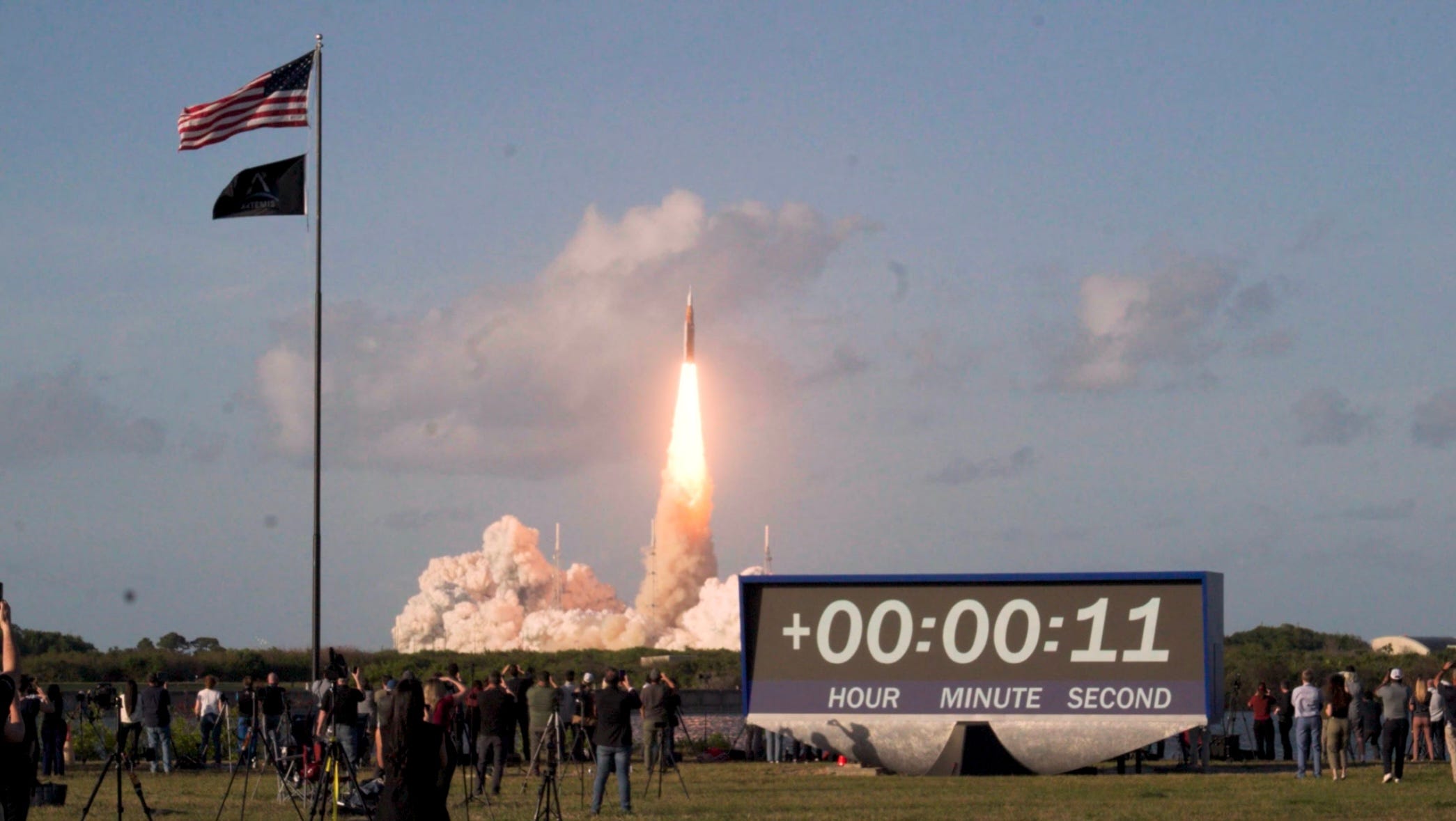
As the iconic countdown clock at the press-site lawn got closer to L-00:10:00, I knew the clock would pause, but I began to have my doubts. When it finally paused, there was a collective sigh of relief in our set. We were inside a 30 minute hold to give the teams in the firing room time to check all systems before giving the approval to fly to the moon. The countdown clock restarted. We were inside the terminal count, the last 10 minutes before launch, and as the clock continued there was a cautious excitement that took over. The likelihood of launch increases, but there could always be another hold or a scrub. The clock never stopped and reached all zeros across the screen.
The first thing you see is the cloud of smoke peeking over the launch pad trench before it quickly turns into a massive cloud racing away from the rocket in opposite directions. Then, a light sprouts from under the rocket. It grows incredibly bright, so much that it doesn’t let you see the rocket itself clear the tower. At T+10, or ten seconds after liftoff, you slowly start to hear the rumble of the four RS-25 engines and the two solid boosters that flank the core stage of the rocket. The sound increases exponentially as the Space Launch System (SLS) continues its curved climb towards outer space. The cracking thunder drowns everything, it rattles all structures around you and it pulses through your body even as the SLS now looks like a tiny orange spec against the blue sky.
Our launch commentator described milestone after milestone during launch -- Max Q, Booster Separation, MECO, and finally, ICPS separation, the astronauts are now officially in space -- all in Spanish.
Back home, my mother, who watched Neil Armstrong step on the moon when she was nine years old, translated what was happening to my wife who doesn’t speak Spanish. It makes me happy knowing that I brought her another lunar mission broadcast more than fifty years later. This time, watching with her granddaughter, as a woman goes to the moon.
Watch Nasa’s free on demand streaming service here. You can also watch the International Space Station stream here.
Here’s what’s happening this week.
Monday, April 6
1 p.m. | Official NASA broadcast of the Artemis II flight around the Moon. Stream on YouTube, HBO Max, Amazon Prime, Peacock, Netflix, NASA+
Tuesday, April 7
4 p.m. | Daily news conference on Artemis II. Stream on YouTube
Wednesday, April 8
8:30 a.m. | Launch coverage of NASA’s Northrop Grumman CRS-24 mission to the International Space Station. Launch scheduled for 8:49 a.m. Stream on YouTube, NASA+
3:30 p.m. | Daily news conference on Artemis II. Stream on YouTube
Thursday, April 9
3:30 p.m. | Daily news conference on Artemis II. Stream on YouTube
Friday, April 10
12:30 a.m. | Coverage of the rendezvous and capture of NASA’s Northrop Grumman CRS-24 mission to the International Space Station. Capture scheduled for 1:10 p.m. Stream on YouTube, NASA+
Bio: Pedro Cota is a Senior Media Specialist at the National Institute of Aerospace and a NASA contractor. He is part of Space 360, a production team that creates a wide variety of communications products for NASA. Pedro has a Bachelor of Arts in Film and a Masters in Journalism from UC Berkeley. He was born in San Diego, CA and was raised in Tijuana, Mexico. His bicultural heritage has led him to produce content in both English and Spanish. Some of his achievements include producing the first broadcast in Spanish of a planetary landing with the Mars 2020 Perseverance mission, he was a Student Academy Award Finalist in the short documentary category and was part of the team that won the Webby for People’s Voice Winner Social Events & Live Streaming for NASA’s coverage of the James Webb Telescope Launch.